





Jump To
- Start by Defining Your Project
- Where to Find Kitchen Remodeling Contractors
- What to Look For in a Kitchen Remodeling Contractor
- Verify License and Insurance in New York
- How to Compare Quotes and Contracts
- Protect Your Deposit
- Your First Call Tells You a Lot
- Red Flags to Walk Away From
- Frequently Asked Questions
A kitchen remodel lives or dies on one decision. That decision is not about the tile, the cabinet color, or the countertop, but the contractor. The best design in the world can fall apart if it is in the wrong hands, while a good contractor can make even a modest budget look impressive. That is why you should take the time to make the right choice. Get this decision right, and everything else becomes easier.
The trouble is that every contractor looks great on their own website. Sorting the reliable ones from the risky ones takes a little know-how, and here in the Hudson Valley, there are specific things to check that a national guide will never tell you.
We remodel kitchens across the region, from Mt. Kisco and the surrounding Westchester and Putnam towns up through Ulster, Dutchess, and Orange counties, and this guide walks through how to hire a contractor for a kitchen remodel the right way.
Start by Defining Your Project
Before you call anyone, get clear on what you actually want. A contractor cannot give you a useful quote, and you cannot judge whether they are a fit, until the scope is defined.
Ask yourself a few questions. Are you updating cabinets and countertops, or changing the whole layout? Do you want to keep the existing footprint or move walls, plumbing, and electrical? Do you have a firm budget, and how flexible is it if the scope grows?
Knowing your answers lets you communicate clearly and match your project to a contractor who does that kind of work.
This last point matters more than people expect. Plenty of contractors take kitchen jobs, but not all of them are comfortable working within an existing footprint or updating only part of a kitchen. Knowing your scope up front helps you find one who is.
Where to Find Kitchen Remodeling Contractors
Start with people you trust. A recommendation from a friend, neighbor, or coworker who has had a kitchen remodeled is worth more than any advertisement because it comes with a real, first-hand account of what the experience was like. If you are new to the area, ask your realtor or post in a local neighborhood group where people share recommendations.
Online reviews are another helpful way to evaluate a contractor. Do not focus only on the star rating. Read the detailed reviews to see what past customers say about their experience. Look for patterns in the feedback, such as repeated complaints about poor communication, delays, or unfinished work. Also, be careful if a contractor has many bad reviews under one account and then suddenly starts using a new account with no review history.
Cross-check the contractor's name on Google and with the county consumer protection resources covered below.
Then look at their portfolio. Photos can show you the contractor's style and range of work, but one of the strongest signs of quality is a completed project you can visit in person or a past client who is willing to talk about their experience. A contractor who is proud of their work will usually be happy to provide both.
What to Look For in a Kitchen Remodeling Contractor
A few qualities separate a contractor who will serve you well from one who will not.
Kitchen experience above all
Kitchens have challenges that other rooms do not, from tight layouts to plumbing, ventilation, and coordinating several trades in a small space. A contractor who regularly remodels kitchens has dealt with these challenges before and knows how to solve them.
A track record in the community
A contractor who has worked in the area for years and built a strong reputation among local homeowners has more to protect than a contractor who is only here for a short time. Longevity is not a guarantee, but it is a good sign.
Clarity about who runs your job
This is a question many homeowners forget to ask. How many crews does the company have, and who will supervise your project each day? Will that person be on-site, or will they be managing several other jobs at the same time?
Knowing who will actually be working in your home and who is responsible for the work can tell you a lot about how smoothly your project will go.
Verify License and Insurance in New York

This is where local knowledge matters most, and where the national guides fall short. New York handles contractor licensing in a way that surprises many homeowners.
There is no statewide home improvement contractor license. The state does not issue one. Licensing is handled locally, which means the rules depend on where your home sits.
Westchester County requires home improvement contractors to hold a county license, administered by the Westchester County Department of Consumer Protection. The department maintains a public list of licensed contractors, along with a list of what it calls renegade renovators that consumers should avoid. You can confirm a contractor's status, or check for outstanding judgments, by contacting that office directly.
This is not a paperwork formality. Westchester takes it seriously enough that its inspectors run enforcement sweeps. In one five-week effort, the department conducted more than 570 inspections and found nearly 100 companies working without a license. Hiring an unlicensed contractor is not a small risk in this county.
For homes in the Ulster, Dutchess, and Orange county areas, requirements vary by town and county, and many upstate jurisdictions handle this at the local level rather than through a county license. The safe move is the same everywhere. Before you sign, confirm what your specific town and county require, and verify that your contractor meets it.
Insurance is the other must-check. A properly insured contractor carries general liability coverage and workers' compensation, which protects you if someone is hurt or something is damaged on your property. Ask for proof directly, and confirm it is current before any work starts. A contractor who hesitates to show it is telling you something.
How to Compare Quotes and Contracts
Get at least three quotes, and insist that each one is itemized. A quote that breaks out materials, labor, permits, and timelines lets you compare real value, not just a bottom-line number. A one-line "kitchen remodel, this much" is a warning sign on its own.
It helps to know what kind of contract you are being offered, too. A fixed-price contract sets the total in stone, which is good for budgeting but can make a contractor less flexible. A cost-plus contract charges you for materials and labor plus a fee, which offers flexibility but less cost certainty. A guaranteed maximum price contract caps what you can be charged but often limits scope changes. None is automatically better. What matters is understanding which one you have.
Whatever the structure, New York law sets a floor for what a contract must contain. Any home improvement contract of $500 or more is required to be in writing and to include the start and completion dates, a description of the work, and the payment schedule. Never agree to a handshake. Everything, the scope, the materials by brand and model, the payments, the timeline, belongs in writing. For a sense of what kitchen projects actually run in this area, our kitchen remodel cost guide breaks down the numbers.
Protect Your Deposit
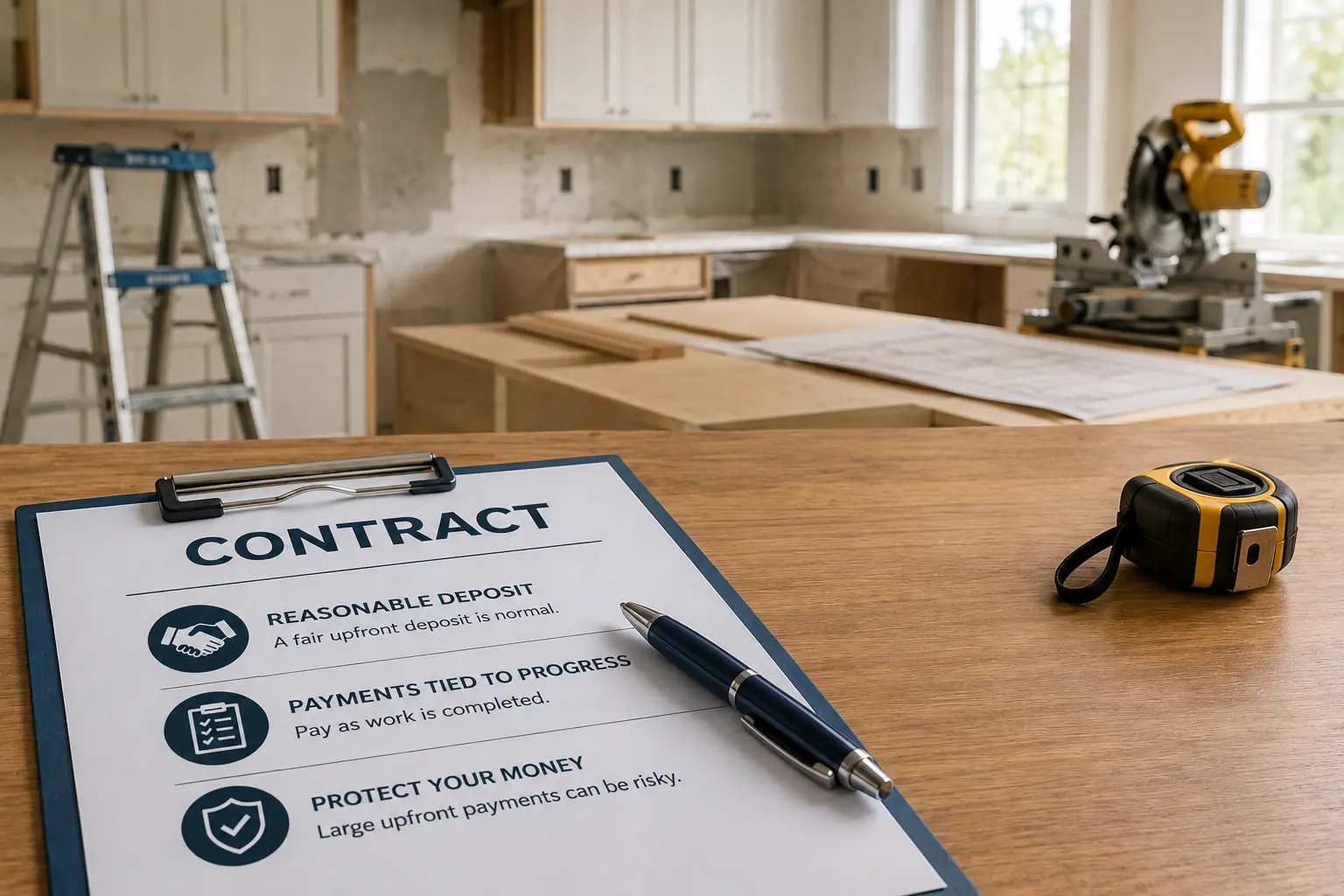
One more piece of New York consumer protection is worth knowing. When you hand a contractor a deposit, that money is meant to be handled carefully, not spent on another client's job. State law requires contractors to treat homeowner deposits with specific safeguards, and misusing those funds can be a legal violation.
Practically, this means being cautious about large upfront payments. A reasonable deposit followed by payments tied to progress is normal. A demand for most of the money before work begins is a reason to pause.
Your First Call Tells You a Lot
Pay close attention to how a contractor communicates before you hire them, since it predicts how the whole project will go.
Responsiveness is the first tell
A contractor who takes days to reply to your first inquiry, or who is hard to pin down for a straight answer, is showing you their pattern. The good ones reply quickly and treat your project like it matters. Homeowners often remove a company from consideration simply because its early responses are slow or unclear, and they are usually right to do so.
Clarity is the second
A contractor who explains their process, timeline, and pricing in plain terms, and who asks thoughtful questions about what you want, is one you can work with. If everything feels like "we'll figure it out later," that vagueness tends to follow into the build.
Finally, trust your gut
If something feels off in those first conversations, it rarely improves once the walls are open. It is fine to walk away.
Red Flags to Walk Away From
A quick summary of the warning signs worth heeding.
- No verifiable license for your town or county, or reluctance to discuss it.
- No proof of insurance, or coverage that is expired or vague.
- A one-line quote with no itemized breakdown.
- Pressure for a large payment up front before work begins.
- Slow, unclear, or evasive communication from the very first contact.
- No real references or projects you can go see.
- A price far below every other bid, which usually means corners will be cut somewhere.
Frequently Asked Questions
How do I verify a kitchen contractor's license in New York?
In New York, home improvement licensing requirements are handled locally rather than statewide. In Westchester County, you can verify a contractor's license through the County Department of Consumer Protection, which maintains a public list of licensed contractors. In Ulster, Dutchess, and Orange counties, check with your local town or county to find out what licensing requirements apply. Always verify that the contractor is properly licensed before signing a contract or making a payment.
How many quotes should I get for a kitchen remodel?
Get at least three quotes, with each one clearly breaking down the costs for materials, labor, permits, and the project timeline. Comparing detailed quotes helps you see what you are actually getting for your money. Be cautious of any bid that is much lower than the others, as a large price difference may mean something has been left out or costs have been cut somewhere.
What should a kitchen remodel contract include?
In New York, any home improvement contract for $500 or more must be in writing. The written document must include the start and completion dates, a description of the work, and a payment schedule. Beyond these legal requirements, make sure the contract also lists the materials by brand and model and clearly describes the full scope of the work.
Is a bigger deposit a red flag?
A reasonable deposit with the balance tied to progress is normal. A demand for most of the cost up front is a reason to pause. New York law requires contractors to handle deposits carefully, and misuse can be a violation.
What is the most overlooked step in choosing a contractor?
The most overlooked step is paying attention to how a contractor communicates before you hire them. Slow or vague replies early on can be a warning sign of communication problems during the project. Responsiveness, clear explanations, and thoughtful questions during your first conversations are strong signs of a contractor worth hiring.
Ready to Find the Right Kitchen Remodeling Contractor?
At Keen Improvements, we bring over 30 years of experience to kitchens across the Hudson Valley, and we are licensed, insured, BBB A+ accredited, and NKBA certified. If you would like to see how we work, our kitchen remodeling page walks through our process, and our guide to kitchen remodeling mistakes to avoid covers what to watch for once your project is under way.
We remodel kitchens across Westchester, Putnam, Ulster, Dutchess, and Orange counties. Ready to talk? Contact us for a free estimate.
Get Your Free Estimate
Mt. Kisco
118 N Bedford Rd #100, Mt Kisco, NY 10549
(914) 410-6209
(914) 410-6209
Marlboro
63 South St, Marlboro, NY 12542
(845) 440-1010
(845) 440-1010